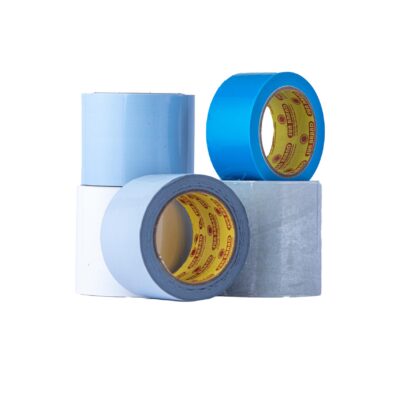

Copper Foil Tape

Copper Foil Tape
- Copper foil tape is a flexible copper foil coated with high conductive adhesive & comes with a release liner.
- Ideal for EMI/RFI shielding & as well as shielding of all non-conductive materials & electrical grounding.
- Excellent for soldering application & for anti-static floors (ESD floors).
- Can be used as an electrical connection between surfaces & cable shielding.
- Available in roll & die-cut forms.
More about Copper Foil Tape from Adhesive Specialties
What are Copper Foil Tapes?
Copper Foil Tape has a conductive adhesive coating. Its aggressive adhesion results in superior bonding, making it a popular choice in a variety of consumer and industrial applications. It has a very low electrical resistance, is conductive by nature, and comes with a removable lining for easy handling.
Application and Techniques
- Copper Foil Tape is a premium product that is perfect for grounding, soldering, and RFI/EMI (Electromagnetic Interface) shielding in the electrical and electronic sectors.
- The tape’s easy-to-remove liner allows it to be used for a variety of die-cut applications.
- Make sure the surface is clean, dry, and dust-free before applying the tape for best results. For better adhesion, apply uniform and strong pressure.
Storage and Shelf Life:
The tape should be kept in a cool, dry area and should not be exposed to direct sunlight for lengthy periods of time. The product should be used within 12 months of the manufacturing date to get the best results.
Uses of Copper Foil Tapes in Various Industries
Construction and Interiors Industry:
Adhesive tapes are utilized throughout the construction and interiors industry, from the beginning to the ultimate product.
Adhesive tapes are used in the construction and interior design industries for bonding, constructing, sealing, and protecting, among other things. Adhesive Tapes are also simple to use and have an aesthetic as well as a long-lasting appeal, which has contributed to their widespread use in the business.
The following are some of the most common adhesive tape applications in this industry:
- Window sealing and glazing
- Mirrors, glass, deco pieces, window trimmings, and other items are installed.
- Door panels, stiffeners, and other items are bound.
- Cladding for the walls
- skirting and floor coverings
- Cable management and soundproofing
- Window perimeter joints and gaps must be filled.
- Insulation
- Applications for roofing
- Electrification
- Applications in plumbing
HVAC (Heat, Ventilation, and Air Conditioning) is a system that functions.
Electronics Manufacturing & PCB Repair:
Copper Foil Tape is widely used in circuit board repairs, conductive path creation, and component bonding. As a copper adhesive tape for electronics, it enables precise rework of damaged PCB traces. It also stabilizes micro-components during soldering. Its conductive adhesive version creates instant electrical pathways, reducing assembly steps. The tape’s flexibility allows it to conform to complex board geometries, making it essential for prototyping and engineering labs.
EMI/RFI Shielding Applications:
As an EMI/RFI shielding tape copper, it protects sensitive devices from electromagnetic interference in high-frequency environments. It is applied inside electronic housings, around cables, and inside instrument panels. The copper foil blocks unwanted signals, improving device stability and signal clarity. It is widely used in audio devices, communication systems, avionics, and industrial electronics. Its shielding effectiveness helps products meet global EMC compliance standards.
Grounding & Electrical Bonding:
Copper Foil Tape acts as a reliable grounding copper foil tape to create low-resistance grounding paths in electrical assemblies. It is used on cabinets, panels, and enclosures to equalize potential and prevent static discharge. In cable shielding, it enhances grounding continuity. The strong conductive adhesive ensures consistent bonding even on irregular surfaces. It is ideal for electrical panels, EV components, instrumentation, and static-sensitive environments.
Thermal Management & Heat Dissipation:
As a thermal conductive copper tape, it is used for dissipating heat from LEDs, processors, batteries, sensors and compact circuitry. The copper foil spreads heat evenly, reducing hotspots and improving lifespan of electronic components. It is also used in cooling assemblies, heat sinks, and temperature-sensitive devices. Its combination of adhesion, conductivity and flexibility makes it ideal for thermal engineering applications. It maintains performance in both high and low temperature conditions.
Automotive, Aerospace & Industrial Equipment:
In automotive and aerospace systems, copper foil tape is applied for shielding electronic modules, grounding vehicle components, and supporting thermal insulation. Its durability and corrosion resistance make it suitable for harsh conditions. It helps reduce electrical noise in control systems and ensures stable performance in navigation and communication equipment. The tape conforms to curves and complex structures, making it versatile for both OEM and maintenance operations.
Description
What is Copper Foil Tape
Copper foil tape is a thin metallic tape made from pure copper foil with pressure-sensitive adhesive. It is used for EMI (electromagnetic interference) shielding, RF grounding, PCB trace repair, transformer electrostatic shielding, and decorative applications like stained glass work. Copper foil tape is available with conductive or non-conductive adhesive.
Adhesive Specialities manufactures copper foil tape for electronics, telecommunications, and industrial applications. Our copper tapes provide excellent electrical conductivity, solderability, and conformability for EMI shielding and grounding requirements.
Product Specifications
| Property | Specification |
|---|---|
| Material | Electrolytic copper foil |
| Purity | 99.9% copper |
| Foil Thickness | 25, 35, 50 microns |
| Adhesive Options | Conductive acrylic / non-conductive acrylic |
| Conductivity | Very high (copper) |
| Solderability | Yes (copper surface accepts solder) |
| Temperature Range | -20 to 120°C |
| Available Widths | 6mm, 12mm, 25mm, 50mm, custom |
| Available Formats | Roll, die-cut shapes |
Conductive vs Non-Conductive Adhesive
For EMI shielding, conductive adhesive is essential. It ensures electrical continuity through the adhesive layer at tape overlaps, creating a continuous conductive barrier. Non-conductive adhesive creates an insulating gap at seams, reducing shielding effectiveness.
For soldering and grounding applications where the copper surface will be directly contacted, non-conductive adhesive is sufficient and more cost-effective.
Applications
EMI Shielding
Copper foil tape wraps around cables, connectors, and enclosures to block electromagnetic interference. It is used in telecommunications, medical electronics, and automotive electronics where EMI compliance is mandatory.
PCB Repair and Prototyping
Engineers use copper foil tape to repair broken PCB traces, create additional ground planes, and modify circuit layouts during prototyping.
Transformer Shielding
A layer of copper foil between primary and secondary windings reduces inter-winding capacitance and common-mode noise in power supplies.
Grounding
Copper foil tape creates grounding connections and static dissipation paths on equipment, enclosures, and workbenches in ESD-sensitive environments.
Frequently Asked Questions
What is copper foil tape used for?
Copper foil tape is used for EMI shielding on cables and enclosures, PCB trace repair, transformer electrostatic shielding, RF grounding, and stained glass crafts. Its conductivity and solderability make it essential in electronics.
Does copper tape need conductive adhesive?
For EMI shielding at tape overlaps, yes. Conductive adhesive ensures electrical continuity across seams. For soldering, grounding through direct contact, or decorative use, non-conductive adhesive works fine.
Can copper foil tape be soldered?
Yes. The copper surface accepts solder regardless of adhesive type. This makes it useful for PCB repair, grounding connections, and prototyping.